
Choosing a VPN is no longer just about hiding your IP address. A good VPN should protect your traffic on public Wi-Fi, minimize the amount of information it collects, offer reliable speeds, and provide useful features without making the service difficult to use.
Proton VPN is one of the most recognizable privacy-focused VPN services available today. Developed by the company behind Proton Mail and headquartered in Switzerland, Proton VPN has built much of its reputation around privacy, transparency, open-source software, and a strict no-logs policy.
But privacy claims alone don’t make a VPN great. The real question is whether Proton VPN provides a good combination of security, performance, features, usability, and value.
After looking at its current features and policies, Proton VPN remains one of the more compelling choices for privacy-conscious users in 2026. Its free plan is particularly unusual because it offers unlimited data without advertising-based monetization, while the paid plans add a much larger server network, streaming support, P2P, Secure Core, NetShield, and other advanced features.
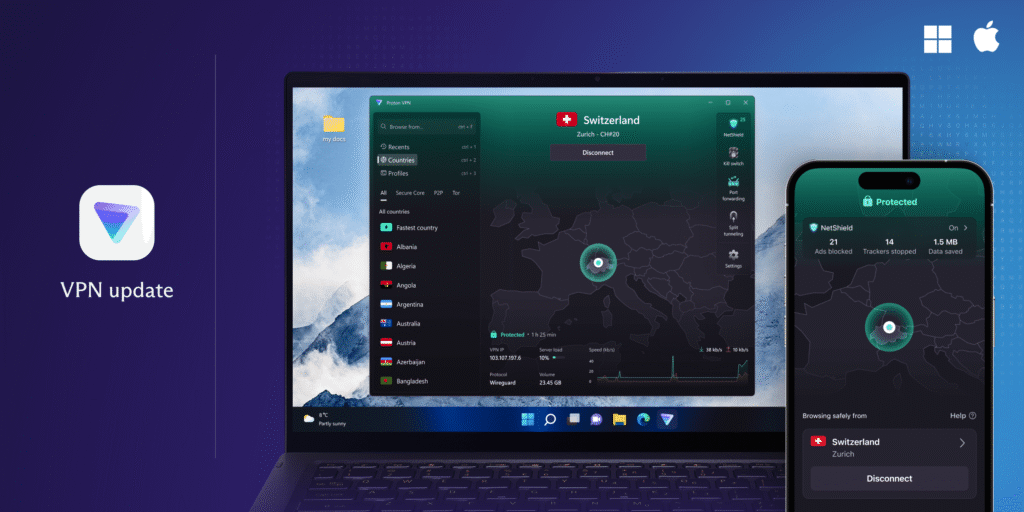
What Is Proton VPN?
Proton VPN is a virtual private network service operated by Proton, the Swiss company best known for Proton Mail.
A VPN creates an encrypted connection between your device and a VPN server. Instead of websites seeing your normal public IP address, they generally see the IP address of the VPN server. Your internet provider also has less visibility into the specific websites and services you access through the encrypted VPN tunnel.
Proton VPN takes this privacy approach further by emphasizing a strict no-logs policy, open-source applications, independent security audits, and Swiss jurisdiction.
The service is available on major desktop and mobile platforms, and Proton also provides a browser extension and support for features such as split tunneling and Tor over VPN on supported plans and platforms.
Proton VPN Privacy and Security
Privacy is probably the biggest reason to consider Proton VPN.
According to Proton’s current no-logs policy, the company does not record the websites you visit, your traffic or communications content, your IP address, session lengths, or location-based information. Proton says its no-logs policy has also been independently audited.
That’s important because a VPN provider effectively becomes an intermediary between you and the internet. If a VPN company collected extensive browsing information, you could simply be replacing your ISP’s visibility with the VPN provider’s visibility.
Proton’s approach is designed to minimize that problem.
The company is headquartered in Switzerland, and Proton says Swiss law does not require it to retain VPN connection logs. Its July 2026 transparency report also explains how legal requests are handled under Swiss law.
Independent Audits
Another strong point is that Proton doesn’t rely solely on saying, “trust us.”
The company publishes the results of independent audits of its software and no-logs infrastructure. Proton says its no-logs policy has passed multiple external audits, with the latest results incorporated into its published audit information.
No VPN can offer absolute anonymity, and an audit isn’t a magical guarantee that a company can never make a mistake. However, independent auditing is considerably more convincing than an unverified privacy claim.
Open-Source Apps
Proton VPN’s applications are open source. This allows researchers and security professionals to inspect the code rather than requiring users to blindly trust proprietary software.
Proton also commissions independent security audits of its applications and publishes the results.
For technically minded users, this is a significant advantage.
Encryption and VPN Protocols
Proton VPN supports modern VPN protocols, including WireGuard, and has also developed additional protocol implementations aimed at performance and censorship resistance.
WireGuard is particularly important because it is designed to be simpler and more efficient than older VPN protocols. Proton says it is increasingly focusing its applications around WireGuard and has been developing a new client-side protocol codebase called Proton Protocols.
Proton also offers Stealth technology designed to make VPN traffic harder to identify and block. This can be particularly useful in countries or networks where VPN connections are restricted.
For ordinary users, the main takeaway is simple: you don’t need to understand cryptography to use Proton VPN securely. The applications handle protocol selection and connection management for you.
Kill Switch
A kill switch is an important VPN feature because VPN connections can occasionally drop.
Without a kill switch, your device could potentially reconnect to the normal internet connection without the VPN, exposing your regular IP address.
Proton VPN includes a kill switch in its applications. When enabled, it can block internet traffic if the VPN connection is interrupted. Proton also provides an Always-on VPN feature designed to automatically reconnect the VPN connection.
This is particularly useful when using a laptop or phone on unreliable Wi-Fi networks.
Secure Core: Proton VPN’s Advanced Privacy Feature
One of Proton VPN’s more distinctive features is Secure Core.
Secure Core is essentially a multi-hop VPN configuration. Instead of your traffic going directly from your device to the final VPN server, Proton routes it through a hardened Secure Core server first.
Proton says its Secure Core servers are located in Switzerland, Sweden, and Iceland and are owned and operated by Proton. The company also says these servers use full-disk encryption and are housed in high-security facilities.
The idea is to provide an additional layer of protection against certain advanced attacks or compromised VPN infrastructure.
For most everyday users, Secure Core probably isn’t necessary. If you’re simply trying to secure your connection at a coffee shop, regular WireGuard protection is likely sufficient.
For journalists, activists, researchers, or people with unusually high privacy requirements, however, Secure Core is a useful additional layer.
The downside is that routing traffic through multiple servers can reduce performance compared with a normal VPN connection.
NetShield Ad and Malware Blocking
Paid Proton VPN plans include NetShield, a DNS-based filtering feature designed to block advertisements, trackers, and malware domains.
This can provide two benefits.
First, it can reduce the number of unwanted advertising and tracking requests made by your browser. Second, blocking malicious domains can provide an additional security layer.
It shouldn’t be considered a replacement for dedicated antivirus or browser security tools, but it is a useful feature to have built into a VPN. Proton says NetShield operates at the DNS level and can block ads, trackers, and malware.
Proton VPN Speed
VPNs inevitably introduce some overhead because your traffic has to be encrypted and routed through another server.
Modern protocols such as WireGuard have made that performance penalty much smaller than it used to be.
Proton VPN also operates high-speed servers and offers VPN Accelerator technology intended to improve performance, particularly over longer-distance connections. Proton claims VPN Accelerator can improve speeds by more than 400% in some circumstances, although this should be treated as a vendor claim rather than a guaranteed real-world result.
Actual performance will depend heavily on your location, ISP, distance to the VPN server, server load, protocol, and the destination website.
In other words, don’t expect every Proton VPN connection to run at your full internet speed.
For normal browsing, video calls, downloading, and HD streaming, however, modern VPN technology is generally fast enough that many users won’t notice a major difference.
Streaming
Streaming is one of the most popular reasons people purchase VPN subscriptions.
Proton’s paid plans advertise support for secure streaming and access to streaming services from different countries.
However, streaming services actively try to identify and block VPN IP addresses. As a result, VPN streaming performance can change over time.
A server that works with a particular streaming platform today might not work tomorrow.
This is worth mentioning in a serious review because no VPN provider can realistically guarantee permanent access to every streaming service in every country.
If streaming is your primary reason for buying a VPN, you should test the services you actually use during the refund period rather than relying entirely on marketing claims.
P2P and Torrenting
Proton VPN supports P2P and BitTorrent traffic on its paid service.
This makes it a potentially attractive option for users who want to protect their IP address while using legitimate peer-to-peer services.
As always, a VPN doesn’t change copyright law. It protects the network connection; it doesn’t make unlawful activity legal.
Proton VPN Free Plan
This is arguably Proton VPN’s biggest selling point.
Many free VPN services impose severe limitations, display advertising, restrict bandwidth, or use free users as a way to generate revenue through data collection.
Proton’s free model is different.
The company offers a free VPN with unlimited bandwidth and says it does not sell user data or use privacy-invasive advertising to fund the service. The free plan follows the same no-logs policy as the paid plans.
The free version is nevertheless limited compared with Proton VPN Plus.
According to Proton’s current plan information, free users have access to servers in a limited selection of countries, can connect one device at a time, and don’t get the full set of premium capabilities.
For basic privacy on public Wi-Fi or occasional VPN use, the free plan is surprisingly capable.
It’s also a good way to test the software before spending money.
Proton VPN Paid Plans
The paid VPN Plus plan is where Proton VPN becomes a much more complete VPN service.
Proton currently advertises VPN Plus with more than 20,000 servers in 140+ countries, connections on up to 10 devices simultaneously, NetShield, Secure Core, streaming support, P2P, split tunneling, and other advanced features.
Proton also sells broader subscription bundles such as Proton Unlimited, which combine the VPN with other Proton products including Proton Mail, Proton Drive, Proton Pass, and Proton Calendar.
That means the value proposition depends on what you need.
If you only want a VPN, VPN Plus is the more relevant comparison.
If you already want private email, encrypted cloud storage, and a password manager, a broader Proton bundle may make more financial sense.
Proton also offers a 30-day money-back guarantee on paid plans, allowing users to test the service with less financial risk.
Ease of Use
One of the strengths of Proton VPN is that it doesn’t require technical knowledge.
The typical workflow is straightforward:
- Install the application.
- Log in.
- Choose a server or use Quick Connect.
- Press the connect button.
- Leave the VPN running in the background.
Advanced users can explore settings for protocols, Secure Core, split tunneling, kill switch behavior, and other features.
This combination of simplicity and configurability is one of the reasons Proton VPN appeals to both beginners and experienced privacy users.
Proton VPN on Multiple Devices
Paid users can connect multiple devices simultaneously. Proton currently lists up to 10 simultaneous connections for VPN Plus.
That is enough for many households where you might have a phone, laptop, tablet, and desktop connected at the same time.
If you want to protect a larger number of devices, installing Proton VPN on a compatible router can also be an option, depending on your setup.
What I Like About Proton VPN
There are several things that stand out positively.
1. Strong privacy positioning
Proton’s no-logs policy, Swiss jurisdiction, independent audits, and open-source applications make its privacy claims more credible than those of many less transparent VPN providers.
2. Excellent free plan
The free version is genuinely useful rather than simply being a trial with extremely restrictive limitations. It provides unlimited bandwidth and a no-logs approach without advertising-based monetization.
3. Advanced security features
Secure Core, kill switch, DNS leak protection, Tor over VPN, and modern VPN protocols provide plenty of options for privacy-focused users.
4. Open-source applications
Being able to inspect the application code is a significant transparency advantage.
5. Strong ecosystem
People already using Proton Mail or other Proton products may appreciate having their VPN integrated into the same privacy-focused ecosystem.
What I Don’t Like
Proton VPN isn’t perfect.
1. Some of the best features require a paid plan
The free plan is good, but features such as Secure Core, broader server selection, streaming access, P2P support, and NetShield are primarily reasons to upgrade.
2. Secure Core can reduce speed
Adding another VPN hop increases the distance and processing involved in a connection. That’s the price of the additional privacy layer.
3. VPN performance varies by location
Even with a large server network, you won’t necessarily get the same performance from every server. A nearby server will often outperform a distant one.
4. Streaming is never guaranteed
Although Proton supports streaming, VPN detection is an ongoing battle between VPN providers and streaming platforms. Users shouldn’t interpret “streaming support” as a guarantee that every service will work forever.
5. Advanced options can be confusing
For beginners, features such as Secure Core, Stealth, split tunneling, and different protocol options can initially feel overwhelming.
Fortunately, the default configuration is generally sufficient for ordinary users.
Is Proton VPN Good for Privacy?
Yes. Privacy is arguably Proton VPN’s strongest selling point.
The combination of Swiss jurisdiction, no-logs policies, open-source applications, independent audits, Secure Core infrastructure, DNS leak protection, and a kill switch gives Proton VPN a strong privacy-focused design.
That doesn’t mean a VPN makes you completely anonymous.
A VPN doesn’t stop websites from identifying you when you voluntarily log into an account. It doesn’t protect you from phishing, malicious downloads, weak passwords, or every form of browser fingerprinting.
Think of a VPN as one important privacy and security layer rather than an invisibility cloak.
Is Proton VPN Worth It?
For many users, yes.
If you’re looking for a VPN primarily to secure public Wi-Fi, hide your IP address from websites, reduce your ISP’s visibility into your browsing, or add another privacy layer to your everyday internet connection, Proton VPN is a strong option.
The free version makes the decision particularly easy because you can use it without paying for a subscription.
The paid plan becomes more attractive if you need access to a large international server network, streaming, P2P, Secure Core, NetShield, or multiple simultaneous connections.
And if you’re already using Proton’s other privacy services, the broader ecosystem can make the subscription more compelling.
Who Should Use Proton VPN?
Proton VPN is a particularly good choice for:
- Privacy-conscious internet users
- People who frequently use public Wi-Fi
- Travelers
- Users who want a reputable free VPN
- People interested in open-source software
- Users who want a VPN with independent privacy audits
- People who need P2P support
- Users who want advanced privacy features such as Secure Core
- Existing Proton Mail users
Who Might Want Something Else?
Proton VPN may not be the ideal choice if your only concern is finding the absolute cheapest VPN subscription.
It’s also worth comparing alternatives if you have a very specific requirement, such as a particular streaming library, a particular country with unusually restrictive VPN access, or a specialized business VPN setup.
VPN performance and streaming compatibility can change, so the best service for one person isn’t necessarily the best service for everyone.
Final Verdict
Overall rating: 4.5/5
Proton VPN has managed to build something relatively rare in the VPN industry: a service where privacy isn’t merely an extra feature added to a conventional VPN product.
Its open-source applications, independently audited no-logs policy, Swiss jurisdiction, Secure Core architecture, modern protocols, kill switch, and privacy-focused business model make it a particularly attractive choice for people who care about what happens to their data.
The free plan is perhaps the biggest surprise. It provides unlimited data and meaningful privacy protection without the advertising or data-selling model commonly associated with free online services.
The paid plans are more compelling for users who want the complete feature set, including the large international server network, streaming, P2P, NetShield, Secure Core, and multiple simultaneous connections.
There are still trade-offs. VPN speeds vary depending on location and server choice, advanced privacy features can add overhead, and streaming access can never be guaranteed permanently.
Nevertheless, if your priorities are privacy, transparency, security, and a trustworthy company rather than simply finding the cheapest VPN, Proton VPN deserves to be near the top of your shortlist.
For users who aren’t sure whether they need a VPN at all, the free plan is an especially easy way to try it. For privacy enthusiasts who want more control and advanced features, the paid plan offers a considerably more complete package.
Bottom line: Proton VPN is one of the strongest all-around VPN choices in 2026, and its combination of a genuinely useful free tier and serious privacy credentials makes it particularly easy to recommend.